There’s an old legend that a birthmark
or defect indicates the spot where you
received a fatal wound in your past life.
In some cultures, people mark their dead
with soot or paste so they can recognize
them when they are reborn, which has
inspired several researchers to spend
their lives documenting hundreds of case
studies that allegedly reflect this belief. SourceSource 2Source 3
Yeah, that is a good question – why do some scifi twist endings fail?
As a teenager obsessed with Rod Serling and the Twilight Zone, I bought every single one of Rod Serling’s guides to writing. I wanted to know what he knew.
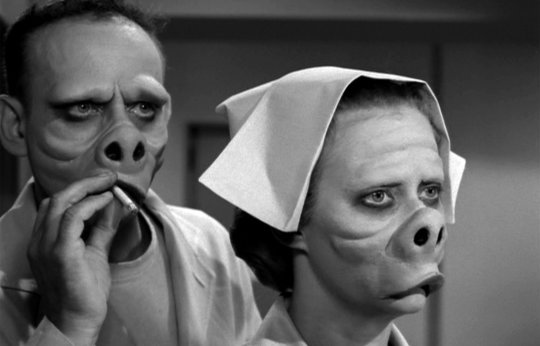
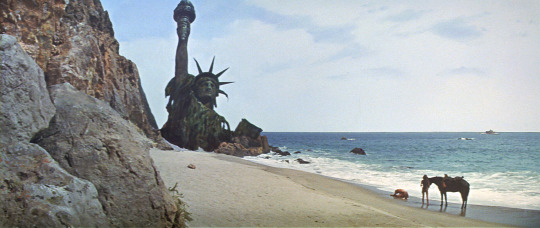
The reason that Rod Serling’s twist endings work is because they “answer the question” that the story raised in the first place. They are connected to the very clear reason to even tell the story at all. Rod’s story structures were all about starting off with a question, the way he did in his script for Planet of the Apes (yes, Rod Serling wrote the script for Planet of the Apes, which makes sense, since it feels like a Twilight Zone episode): “is mankind inherently violent and self-destructive?” The plot of Planet of the Apes argues the point back and forth, and finally, we get an answer to the question: the Planet of the Apes was earth, after we destroyed ourselves. The reason the ending has “oomph” is because it answers the question that the story asked.
According to Rod Serling, every story has three parts: proposal, argument, and conclusion. Proposal is where you express the idea the story will go over, like, “are humans violent and self destructive?” Argument is where the characters go back and forth on this, and conclusion is where you answer the question the story raised in a definitive and clear fashion.
The reason that a lot of twist endings like those of M. Night Shyamalan’s and a lot of the 1950s horror comics fail is that they’re just a thing that happens instead of being connected to the theme of the story.
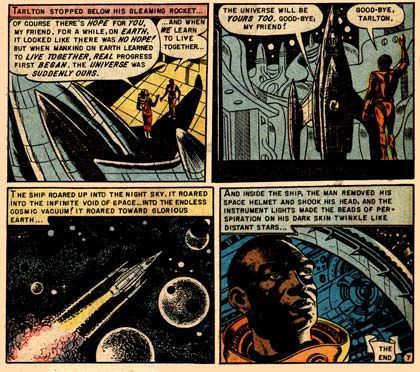
One of the most effective and memorable “final panels” in old scifi comics is EC Comics’ “Judgment Day,” where an astronaut from an enlightened earth visits a backward planet divided between orange and blue robots, where one group has more rights than the other. The point of the story is “is prejudice permanent, and will things ever get better?” And in the final panel, the astronaut from earth takes his helmet off and reveals he is a black man, answering the question the story raised.
As the film’s screenwriter, Arthur Laurents, who was Farley Granger’s lover at the time, explained, ‘There wasn’t a word of dialogue that said [the two men] were lovers or homosexual, but there wasn’t a scene between them where it wasn’t clearly implied.’
aka
“Look for the Force, and you will find me” and the Giant Middle Finger towards
the Chinese Inequalities
So a couple of weeks back, I saw this
video of an interview of Donnie Yen and Jiang Wen, in which someone asked them
about Baze and Chirrut’s relationship. They said a lot of things, mostly
teasing, but the video ended with Donnie smiling and saying, “They’re very good
brothers.”
My immediate, visceral reaction is bull-fucking-shit. And a sense of
absolute glee because I know he knows
that he’s talking bullshit.
I’ve been thinking for the last couple
of weeks about why it’s bullshit.
This post is the result. It’s pretty long, so: tl;dr Chinese culture is about extremely structured and strict societal
relationships, and Baze and Chirrut’s smashes that all into pieces to show how
people can be equal and not fit into boxes.
Disclaimer: I
grew up in a staunchly Chinese family in a Chinese-majority country and grew up consuming media from China, Hong Kong, and Taiwan. But I did not grow up in any
of those places. My country of origin is pretty damned Westernised. If I get
anything wrong, please tell me.
I have brought my tl;dr to a new fandom and I still keep it under a cut.

 Avelera