I wanted to double check that “The Cherry on Top” was a short novel or novella and I found this on uphillwriting.org. I think it’s very informative and hopefully you guys will find it useful!
Let’s say your matrilineal line is fairly consistent and everyone has their daughter at 25. So four women in your matrilineal line are born every hundred years. In a thousand years, that’s only 40 women. Like the math is so simple and yet ? You don’t think about it. So in 2000 years, 80 women. So basically, 0 AD started roughly about 80 mothers ago. That’s it.
I’m……… i’m a little drunk n cannot deal with this right now
Yep
The advent of agriculture around 9500BC was about 450 mothers ago
you can’t just say shit like that without a warning
YES. This whole thread is the best thing and betterbemeta’s tags (above) are on point. I would love actual ‘realistic ancient battles’ where like ten actual fighters and whatever serfs they can persuade to accompany them posture and try to intimidate each other, or have an Official Scrum on a mutually beneficial day. That and just…cattle raiding.
I guess in post-collapse terms it’s theoretically different because your whole raider gang exists to nick other people’s shit so doesn’t need to cultivate or craft much except perhaps to make them more self-sufficient in weaponry, armaments, and other logistical things that’ll enable them to raid harder and more often. That’s exactly why, on the other side of things, as many citizen’s as possible in your vulnerable good-guy farming commune might need to be militia members to protect themselves from people who can dedicate their full-time everyday energy to Being Raiders.
I say in theory because, even if you’re nicking other people’s shit, why not treat that as a bonus? Why not look to history’s peoples who placed a particular import on raiding as a way of life, and notice that none of them were just straight-up predators. They had enough agricultural or pastoral or pescatoral (is that a word?) infrastructure to subsist, and then the luxury, the surplus, came from attacking other people part-time, very occasionally. Look at norse folks going viking; look at the invasive pastoralists of the Eurasian steppe. Just in terms of the caloric requirements and risks inherent in combat, you’re not gonna want to do that full-time. Training to do it well will take more calories and they need to come from somewhere. You pick your battles. You take without fighting at all where you can – so intimidation and making enemies surrender without having to fight is important here; c.f. pirates of the Golden Age – and you fight rarely and only when you know you can a) win, b) benefit hugely from it.
Now, listen, before I begin the part where I scream myself hoarse about the things you’re doing wrong, I want you to understand that we’ve all been there. We’ve all done it poorly. Doing it poorly is the first step to, well, not doing it poorly. I have written my fair share of HOT PUKE, and it’s just one of those things you have to purge from your system.
(Though here we also enter into another caveat: HOT PUKE is not actually a delicacy. You do that shit over in the corner, barfing it up in the potted plant so nobody sees until morning. You don’t yak up today’s lunch in the middle of the living room and then do jazz-hands over it: “Ta-da! The Aristocrats!” What I’m trying to say is, your rookie efforts are not automatically worth putting out into the world, especially if those efforts cost readers money to access them. The mere existence of a story is not justification for its publication. Don’t make people give you cash for your inferior efforts. Get it right before you ask money to reward you for getting it wrong.)
[…]
As always, Chuck Wendig does it best. When it comes to short, concise and practical writing advice, nobody does it better than him. Read it, inhale it, use it.
This is very good advice. In fact, this is so good, I feel like I should print it out, frame it and hang it on a wall somewhere.
Isn’t it just great? I love Chuck Wendig’s advice, practical and of the “wake the fuck up!” kind.
Someone asked if he could edit out all the profanity to republish it on facebook. How in the world??? The profanity is so much part of the package. You can get wise, snotty or calm advice anywhere but only at Chuck’s you get the kind of writing advice that grabs you by the shoulders and shouts at you, “No you DumbFuck, that’s fucking wrong, stop fucking around!”
I love it.
Dialogue, for instance, is one of those things that has rules. And for some reason, it’s one of the most common things I see get utterly fucked. The basic gist of dialogue is:
“Comment,” Dave said.
Right? Quotes, with a comment in the middle, the whole thing broken out with a comma tucked inside the quotes, and then a very simple dialogue tag.
“Comment.” Dave said.
That’s wrong. You need the comma.
“Comment”, Dave said.
That is also wrong. That comma wants to be warm and safe inside the quotes. Where bad writing will never hurt it ever again.
You can, of course, get fancier.
“I’m starting this sentence,” Dave said, “and now I’m going to finish it.”
Or:
“I want to start a new sentence,” Dave said. “Sentences are really cool.”
Note the difference between those two methods. The period versus the comma. The two complete sentences versus the dialogue tag interrupting a continuing sentence.
In the
early 1800s wages for a domestic
servant could be as low as two pounds per year (£68 modern spending worth) but they
would be provided with food, lodging and clothing by their masters. Female servants
earned less but housemaids could earn between six and eight pounds (£203-£272) and a skilled housekeeper up to fifteen pounds a year (£510) By contrast, a footman could expect eight pounds and a coachman anywhere
between twelve and twenty-six (£408-£883) Purchasing power was very different
to today’s.
The two thousand guineas Norrell bid for the books of magic would have been a lifetime’s wages for a craftsman (in the building trade.)
The
guinea Segundus paid for his would have been equivalent to seven days of
wages in the same profession. / sources [X] [X]
I think the line about Mr Norrell paying 210 guineas for his Hanover-square house must be a considerable error on the scriptwriters’ parts. That’s witnessed by the very fact that it comes out to a mere 7500 pounds as calculated in the gifset above. (As does the fact that he is willing to pay nearly ten times that amount for the books at auction.) The book specifies that Miss Wintertowne has an income of a thousand pounds a year and Mr Strange has an income of two thousand. They are obviously rich, but not nearly as much so as Mr Norrell. An income of two thousand would be “quite comfortable” and allow Strange to live in the fashion he is portrayed in the TV series as doing.
I can’t find information on buying a townhouse on a fashionable square, but one site lists the cost of building one on Brunswick Square in the Regency era at 3000 to 5000 pounds. Clearly Mr Norrell would have had to spend something in that range to buy such a house. (He could have “taken” or rented a house of that type for somewhere in the neighborhood of 210 a year, but his point is that he has bought it.)
I find it ironical that he complains in this same scene about how expensive London is. He got quite a bargain!
“What, my homeland? Oh, don’t get me started! Where should I begin?” Follow the directions below to generate the outline of a marvellous, far-away land, and interpret as you see fit.
Geography and Climate (Roll 1d12): 1. A layer of earth and moss scraped across bedrock 2. Dry soil heaped in ever shifting dunes 3. Rocky shores and chilly wind 4. Towering mountains 5. Great climbing hills and sloping valleys 6. Plains stretching beyond the horizon 7. Lowlands pocked with lakes and rivers 8. Fire spewing fissures 9. Deep canyons and deeper caves 10. Dripping forests 11. Scrubby tundra 12. Rugged, tangled evergreens
History (Roll 2d6): 2 -4. Passed from warlord to warlord 5 – 6. Total isolation 7. A slow cultural takeover 8 – 10. Unwavering religious dogmatism 11-12. An unending tug-of-war between factions
Noteworthy Animal (Roll 2d6; if either die shows 1 the creatures are especially large; a 6 means they are prolific; doubles means they are magical in some way): 2 -4. Slinking carnivores 5 – 6. Soaring creatures 7. Stampeding herds 8 – 10. Chattering, dexterous beasts 11-12. Glittering insects
Current Events (Roll 2d6; doubles means there is active conflict): 2. A very valuable natural resource has been found there recently 3-4. A new religion has taken root 5-6. Natural disasters have been common in recent years 7. A benevolent leader has united the people 8-9. A contagious disease is ravaging the population 10-11. Industry has increased recently 12. A religious crusade is beginning
Local Cultures (Roll 1d12 1d4 times): 1. A large people 2. A posh people 3. A nature loving people 4. A diminutive people 5. A warlike people 6. An industrious people 7. A water-dwelling people 8. A reclusive people 9. A festive people 10. A socialist people 11. An oppressed people 12. An ancient people
Sights Worth Seeing (roll 1d12) 1. Vampire falls 2. The Sinkhole 3. The Dead Kahn’s Temple 4. The Stepping Stones 5. The Giant’s Teapot 6. The Green Vortex 7. The Harvest Festival 8. March of the Dead 9. Sunrise Pass 10. Mushroom Hole 11. The Church Below the Earth 12. The Crimson Rain Ceremony
In 1972, she ran away from home. She was gone for several months, and when she got home my grandmother started shaking her and screaming about how someone had told her my mother had no shoes and my grandmother was sure it meant my mom was dead.
She finally calms down, and they piece it together: my grandmother had gotten a phone call from someone who breathed two or three times, said “Cathy’s in bare feet,” and hung up. Except that’s not what they said–my grandmother had written the date in on her calendar, and on that date my mother was in Bare Feet, Arizona. She knew definitively that she was in Bare Feet because on that date she called home to talk to my grandfather, who told her Uncle Jim had died–“got himself shot”–and that she had missed the funeral. Ready for the glitch in the matrix part? Here we go:
–My grandfather had no recollection of the conversation–which would have been a strange conversation indeed, since Uncle Jim was still alive and, in fact, didn’t die until 2009, eight years after my grandfather. However, my mom did miss the funeral, thanks to a delayed flight. Cause of death? Supposedly, it was suicide, but there were enough indications for the family to believe that was a pile of horseshit, not least that shooting himself in the head with the rifle indicated would’ve been near-impossible.
–My mom was going by the name Patricia Danko when she was on the run–she had a fake ID and everything. She hadn’t called herself “Cathy” since leaving home and nobody knew she was traveling under an alias.
–According to my mom, she never gave a name for herself–either Patricia or Cathy–when she was in Bare Feet, and she would’ve had no reason to. Bare Feet had maybe a hundred people in it, and they were just stopping for food and gas.
–This isn’t just an account from my mother–my dad was with her at the time, and he remembers both the phone call and the truckstop.
But that’s not the weirdest nor the creepiest part, which is this:
–I’ve been trying for three years to find Bare Feet, Arizona–on the Internet, on old maps, by talking to old Arizona cowboys, and there was never a Bare Feet, Arizona. My mom convinced my dad to drive “through Bare Feet” on the way back from Texas in 2013 and there was no town anywhere along the highway, not even the abandoned bones of one. I’ve looked for Bare Feet, Barefeet, Bear Feet, Bare Feat, Bare Foot, Barefoot, and Bear Foot. None of these exist.
My mother stopped in a town that doesn’t exist, ate in a restaurant that never was, made a phone call that could not have happened and was apparently answered by a ghost from 40 years in the future, and later that night someone called my grandmother from a number that turned up on her phone bill only as a pay phone in Arizona to say that single sentence, “Cathy’s in Bare Feet.”
I didn’t initially want to reblog things here, but this is just too far up my alley. I think I’ll start collecting stories of incidents like this, weirdling magic at its most potent.
It is very important that the language in your novel reflects the time and place in which the story is set.
For example, my story is set in Italy. My characters would never “ride shotgun”, a term coined in US in the early 1900s referring to riding alongside the driver with a shotgun to gun bandits.
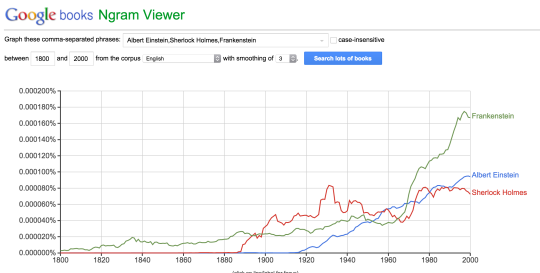
Do your research! A free tool that I found to be very useful is Ngram Viewer.
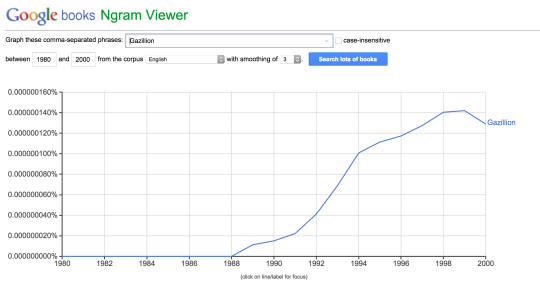
You can type any word and see when it started appearing in books. For example…one of my characters was going to say “gazillion” (I write YA) in 1994. Was “gazillion” used back then?
And the answer is…YES! It started trending in 1988 and was quite popular in 1994.
Enjoy ^_^
This is really important, especially because language can change in very unexpected ways.
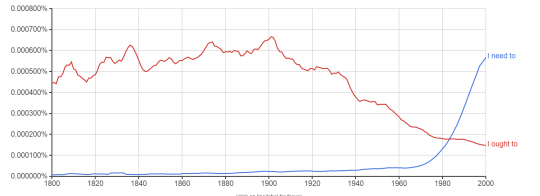
For example, did you know that before 1986 people never said “I need to”?Instead, they were far more likely to say “I ought to”, “I have to”, “I must”, or “I should”.
Don’t believe me?
Anyway, most people won’t notice subtle changes like that. But your reader will notice and be confused when characters in your medieval world use metaphors involving railroads and rockets.
One of the things you can do besides use Google Ngrams is to read books or watch movies written in the time period you want to set your story. The key here is that they can’t just be set in that time period, they have to have been made in that time period.
Also, there’s a Lexicon Valley episode on this very topic which I highly recommend. It’s called Capturing the Past.


 Avelera