Here, this is what I meant about Scots and English being different. It’s definitely worth a watch if you often think “Why do Scottish people type like that”.
A prince with a love of the sea undergoes a terrible shipwreck and wakes, briefly, while being rescued by a mermaid. Obsessed now, he requests the help of a land witch and gives up his “charm” – looks and speech – for a tail. Silent, disfigured, and lost beneath the waves, he discovers that though he can breathe, every breath he takes feels like fire in his chest. Still, he hopes to find the mermaid who saved him and someday earn her heart…
A young, beautiful wolf with a coat as red as blood is off to visit her grandmother – now living in another pack. She’s warned by her mother not to approach the path, for humans lurk there. However, the pup ignores her mother’s advice, lured away by a girl’s tempting treats, and later at dusk, when she finally arrives at grandmother’s, a whole group of hunters sets upon the pack…
A young man is selected to keep a fearful ‘beast’ company, living in a castle far out in the woods. Yet when he arrives, he finds not a beast, but the most gorgeous woman the land has ever seen… one who claims to be under a spell. She is not human and utterly despises this form, but the spell will not be broken until someone loves her for reasons beyond her appearance. This man, gentle and well-read, may one day look past her beauty and if he does, he may still love the ‘beast’ that then springs forth…
A princess is told by her father that she must marry and a ball is planned to find her a husband. Angry and panicking, she flees to the edge of her kingdom where she finds a young man, living with two brothers and an abusive stepfather. These fast friends hatch a scheme: the princess will take one of the man’s shoes, claim it belong to her one true love, and send her father on a fool’s errand to find the ‘prince’ to which it belongs. In return she will help the man escape his family, if he wishes, at least for one night – at the ball. But when they dance together, more than friendship might form…
There are few things as soul-crushing in the writing process (at least to me) than getting a bunch of characters in a room with the intention of something happening, then the characters proceed to stand around and stare at each other.
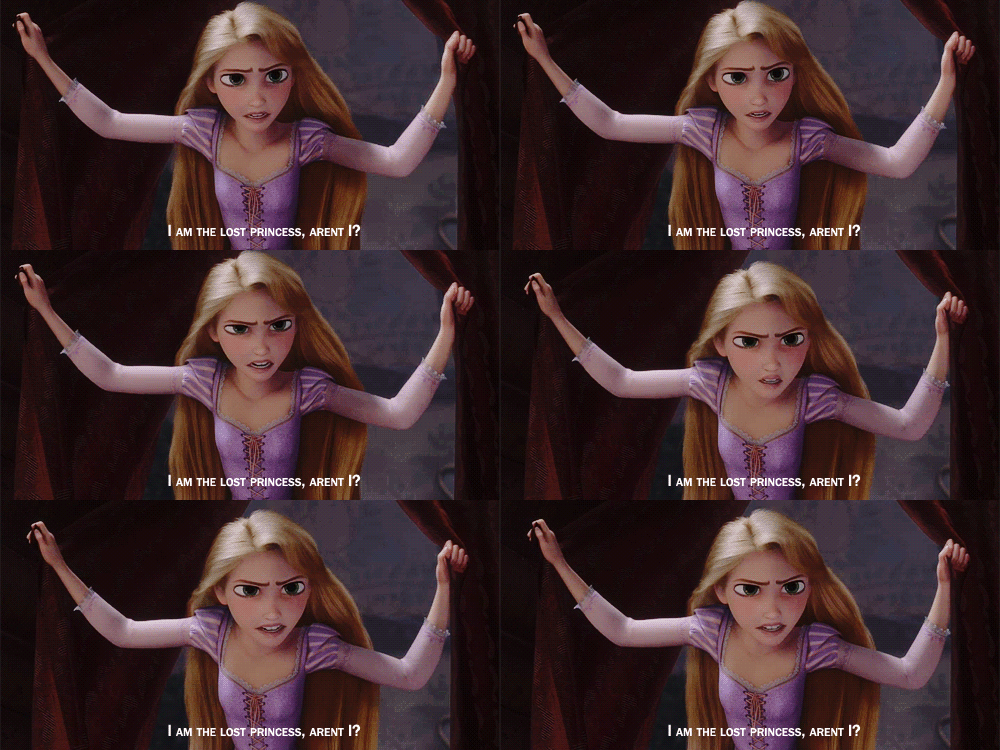
Or worse, look at you like this.
My characters didn’t know why they were there. I didn’t know why they were there either. I had no clue what they were supposed to be doing, so I’d start throwing random instructions at them: “Fight, characters! You guys should fight now! Maybe fighting will make this event have a purpose!” Which inevitably resulted in characters going through the motions of battle for no apparent reason, like they had all lost their minds.
What was the problem? I didn’t know how to write a scene. I didn’t know what a scene was. I had a vague definition that it was something about changing scenery, or just “something happening”.
It’s not. And once I learned what a scene was, my characters got to stop pummeling each other, while wishing they could pummel me.
So what is a scene?
The definition of a scene is kind of like the definition of a story. Story is change, a massive change in the life of your main character. A scene is change too, but much smaller, and part of that huge story change. You couldn’t have the BIG change without these tiny changes. Thus, a scene is not switching scenery. It’s not flipping to a new Character’s POV. It’s one segment of change, which triggers the next change, which triggers the next, which gradually build into sequences, which build into Acts, which build into story.
So what goes into a scene? How does it work?
1. Alternating Charges
If a scene opens positive, it will turn negative by the end. If it opens negative, it will end positive. Simple.
2. Character Goals
Everybody in a scene wants something. If they don’t want anything, they shouldn’t be in the scene. And these characters, with their often opposing goals, are going to employ different tactics on each other to get what they want. Which creates …
3. Escalating Conflict
Conflict is created when one character wants one thing and another wants something else, right? So the characters in the scene are each pushing for something different, each new tactic increasing in determination. And what are these actions called?
4. Beats
The beats of a scene are exchanges of action and reaction. One character does something, another character reacts. All exchanges (beats) are pushing the scene onward, building tension and conflict, until finally …
5. Turns & Revelations
The scene turns. The positive has changed to negative. Something has been discovered. The story has spun in a new direction.
6. Connection to Story Objective
Every scene must be connected to the BIG goal of the story, the main character is taking small actions to reach that big goal. If it isn’t obviously connected to this big plot, it won’t make sense. Your reader won’t know why the heck they’re reading the scene. Which brings us to …
7. Logic & Necessity
Every scene must be necessary. It must be able to be linked with the previous scene. “Because that happened in the previous scene, THIS must happen in this scene.”
So! To see how that all works, let’s break down a scene from Tangled. (Because I used it in the last post to map out how a premise works, and my little writer heart can’t resist symmetry.)
Rapunzel’s Goal: Rise up against her mother – finally.
Gothel’s Goal: Regain control.
Escalating Conflict: They’re fighting over who controls Rapunzel, and this battle causes them to go from “mother and daughter” to “enemies”. The conflict builds nicely in this scene, causing the story turn.
Connection to Story Objective: Throughout the movie, the big thing Rapunzel wants is freedom, she wants her life to begin, she wants to have a new dream. This is the moment she figures out how to do that; it’s not escaping the tower, it’s escaping Gothel’s control over her.
So! Here’s the scene.
Beat 1
“Rapunzel? Rapunzel, what’s going on up there?”
Ignores her. Still processing the tremendous implications of this revelation.
Beat 2
“Are you alright?“
"I’m the lost princess.” (Dumbfounded. Almost whispering it to herself.)
Beat 3
“Oh, please speak up Rapunzel! You know how I hate the mumbling.” (Bullying.)
“I am the lost princess! Aren’t I?” (Fighting back. She will not be bullied anymore.)
Beat 4
Gothel stares, stunned. She’s rendered temporarily speechless, because her secret’s been revealed finally, and her victim is actually fighting against her.
“Did I mumble, Mother? Or should I even call you that?” (Accusing. Drawing herself up taller. Looking down on Gothel and glaring. She’s seeing her clearly for the first time in her life.)
Beat 5
After a pause, thinking up a tactic. “Oh, Rapunzel, do you even hear yourself? How could you ask such a ridiculous question?” (Laughs. Ridicules. Attempts to make her feel childish, dumb, worthy of being mocked. Tactics which have always worked. She even begins to hug her.)
Rapunzel pushes her. “It was you! It was all you!” (Still accusing and angry, but pain is beginning to show. It’s almost like she’s giving her a chance to explain herself.)
Beat 6
“Everything I did was to protect you.” (And Gothel doesn’t say anything redeeming. She’s holier than thou, regal, bestowing kindness on an ungrateful, stupid child. Trying to control through guilt.)
Rapunzel rams her out of the way.
Beat 7
“Rapunzel!” (Shouting. Now trying anger.)
“I’ve spent my entire life hiding from people who would use me for my power …” (Leaves her.)
Beat 8
"Rapunzel!” (Still trying the anger angle.)
“But I should have been hiding from you.” (Throwing the truth at her.)
Beat 9
“Where will you go? He won’t be there for you.” (She’s tried everything else. It’s time to attack her heart.)
“What did you do to him?” (Fear)
Beat 10
“That criminal is to be hanged for his crimes.” (She’s keeping up the disapproving mother act, but striking her right where it will hurt her most.)
“No.” (She’s stopped. Shrinking in on herself. Staring, horrified. And Gothel thinks she’s won.)
Beat 11
“Now, now. It’s alright. Listen to me. All of this is as it should be.” She goes to pat Rapunzel’s head, a gesture symbolic of her superiority, her physical, mental, and emotional control over her victim.
Rapunzel grabs Gothel’s wrist. “No! You were wrong about the world. And you were wrong about me! And I will never let you use my hair again!"
Beat 12
Gothel wrenches free, stumbling backwards in shock and anger, breaking the mirror in the process.
"You want me to be the bad guy? Fine. Now I’m the bad guy.” (Well, now emotional control is over. It’s time to start stabbing Rapunzel’s boyfriend.)
This action has no reaction, interestingly. It leaves us hanging, a cliffhanger created with only beats.
Closing Charge: Negative. She’s now a full-fledged villain, the motherly persona shed, and she’s determined to get what she wants whatever the cost.
Turn: It changed from positive to negative, and now we’ve got a Flynn-stabbing witch to deal with.
Revelation: She’s always been evil. She has always been the bad guy. The motherly act was just that, an act.
Logic & Necessity: This scene fits with the previous scene, and the one that follows.
Though I’ve seen these concepts in many books, the place I first learned about it (and the best resource for scene design in my opinion) is the book Story by Robert McKee. It’s helped me countless times, is one of my favorite books on storytelling, and I highly recommend it if you write anything.
I realize that these definitions were a little vague, so I’ll be explaining things more thoroughly in subsequent posts.
lemme tell you i am so fucking tired of angsty vampires. its enough.
give me a newly-turned twenty-something vampire who hears about their newfound immortality and is like “thank god,” then proceeds to invest in some promising startups and fucks off to take a nap for two decades
give me a vampire thats only the tiniest bit phased at the blood diet because “eh, i tried paleo a while back and it was just as weird”
give me a vampire with self image issues who never has to avoid mirrors again because – bingo – no reflection
give me a genderqueer vampire who finally has an answer when someone asks their gender. “are you a boy or a girl?” “i am a vampire.” “but whats in your pants?” “fangs.”
best of all, give me a vampire chick who is so stoked about being nocturnal because she’s never been able to walk alone after dark before and it’s nice to be able to walk her friends home and know theyre all safe with her
Suspense, Horror and Mystery Genre Differences Infographic
Oh this is interesting! (And I totally get why suspense is my jam now, both as a writer and a reader.)
Most of these three genres combine all three elements in some way as well, now that I think about it. Mystery often includes the element of suspense as in “can we stop them before they kill again?? and is the main character in danger too?” And suspense often contains horror–easier to make the threat the main characters face more real if someone else loses to that threat first. And horror really doesn’t work without at least one of the two elements–if you don’t care about the characters, why do you care if they die?
Since I’m in the middle of rewriting a suspense novel, definitely going to keep all of this in mind…
Since we are featuring Hannibal fandom this month, this little infographic seems appropriate!
(You can read this without the visual aids on AO3.
March 10, 1917 – James Buchanan Barnes is born, and we were all officially fucked.
July 4, 1918 – Steven Grant Rogers is born, and somewhere in Brooklyn Bucky’s mother wept …
June, 1924 – Steve’s mother is bedridden from illness associated with Tuberculosis.
September, 1930 – 12-year old Steve and 13-year old Bucky meet for the first time in Hell’s Kitchen, where Bucky scares off bullies trying to steal Steve’s money. What were they doing in Hell’s Kitchen? No one knows. Steve tells Bucky he’s been living in the orphanage ‘on 8th’ since his mother’s death. Which is odd since Bucky was apparently at her funeral when they’re both legal adults in a flashback scene from the Winter Soldier. For the purpose of this timeline, info from the movies will take precedent over info from the various tie-ins. Meaning Sarah Rogers is basically Schrodinger’s Ma for the next 6 years.
1936 – Shrodinger’s Ma finally actually dies fo sho of Tuberculosis. Bucky breaks everyone and their mother’s heart with his ‘til the end of the line’ line.
look: our neanderthal ancestors took care of the sick and disabled so if ur post-apocalyptic scenario is an excuse for eugenics, u are a bad person and literally have less compassion than a caveman
Yes but they also when extinct which implies whatever they were doing at the time wasn’t fit for their environment.
So, it’s been awhile since I took a human evolution course, so some of this might be a little out of date, but
1) Whether or not Neanderthals went extinct is still kind of up for debate, and seems to hinge largely on whether you think that Neanderthals are a H. Sapiens subspecies or not, which often seems like a mildly pointless argument to me since it’s largely a fight about which definition of “species” to use
2) Even if we argue that Neanderthals are our direct ancestors and never went extinct, several Neanderthal *traits* (like their noses and their forheads) *have* left the population. Care for the disabled is not one of them.
Saying “Neanderthals cared for their sick and injured and are now extinct, therefore care for the disabled is maladaptive” is like saying “Dodos are extinct therefore beaks are a terrible idea”
Statements about “less compassion than a caveman” still stand.
–Peter
I teach human evolution to college students, so in addition to that, here’s what we know. There’s some citations (and footnotes) behind the cut, if you’re interested.
So Neanderthals aren’t our direct ancestor- more like a branch of the family tree that didn’t lead to us. Close cousins- close enough to breed- but they evolved outside of Africa about 400kya, while our species evolved in Africa about 200kya*. This is important because it means that altruism can’t possibly be a Neanderthal trait that left the population during the evolution into modern humans; we didn’t evolve from them, so it’s not like we can say “well, this was maladaptive in our ancestors.” This is a behavior you see in two temporally coexisting species (or subspecies), and I do mean two, because it wasn’t just Neanderthals practicing altruism. We did it too.
We have really good evidence that early Homo sapiens sapiens (i.e., us, just old) also took care of their injured, elderly, and disabled. At Cro-Magnon in France, a few individuals clearly suffered from traumatic injury and illness during their lives. Cro-Magnon 1 had a nasty infection in his face; his bones are pitted from it. Cro-Magnon 2, a female, had a partially healed skull fracture, and several of the others had fused neck vertebrae that had fused as a result of healed trauma; this kind of injury would make it impossible to hunt and uncomfortable to move. This kind of injury can be hard to survive today, even with modern medical care; the fact that the individuals at Cro-Magnon survived long enough for the bones to remodel and heal indicate that somebody was taking care of them. At Xujiayao, in northern China, there’s evidence of healed skull fractures (which would have had a rather long recovery time and needed care);
This evidence of altruism extends past injured adults, as well. One of the most compelling cases is at Qafzeh, which is in Israel. Here we see evidence of long-term care for a developmentally disabled child (as well as a child who had hydrocephaly and survived). Qafzeh 11, a 12-13 year old at time of death, suffered severe brain damage as a child. Endocasts (basically making a model of the inside of the skull, where the brain would be) show that the volume of the brain was much smaller than expected; likely the result of a growth delay due to traumatic brain injury. The patterns of development suggest that this injury occurred between the ages of 4 and 6. They very likely suffered from serious neurological problems; the areas of the brain that were injured are known to control psychomotricity. This means that the kid may have had a hard time controlling their eye movements, general body movement, keeping visual attention, performing specific tasks, and managing uncertainty; in addition, Broca’s area might also have been damaged, which likely would have affected the kid’s ability to speak. Long and short of it, without help, this kid wouldn’t have survived to age 12-13.
But they did. They lived, and they were loved. When they died, they were given a funeral- we know this based on body position and funeral offerings. Mortuary behavior was common among both Neanderthals and archaic Homo sapiens, and this burial was particularly interesting. The body was placed on its back, its legs extended and the arms crossed over the chest. Deer antlers were laid on the upper part of the chest; in the archaeological context, they were in close contact with the palmar side of the hand bones, meaning it’s likely that they were placed in the hands before burial. This points to Qafzeh 11 being valued by the community- why go to the effort for somebody you don’t care about? Compassion is a very human trait, and to call it maladaptive is to ignore hundreds of thousands of years of human experience.
do you ever just want to pull a character from their world for awhile and put a blanket around their shoulders and pat them on their back or hold them while saying how proud you are then maybe get them some hot cocoa and just let them relax for a second because damn they’ve been through some tough shit




 Avelera