“Authors can’t use it in fantasy fiction, eh? We’ll see about that…”
–Terry Pratchett, probably
Try to implement anything but a conservative’s sixth grade education level of medieval or Victorian times and you will butt into this. all. the. time.
There was a literaly fad in the 1890′s for nipple rings for all genders(and NO, it was NOT under the mistaken belief that it would help breastfeeding–there’s LOTS of doctors’ writing at the time telling people to STOP and that they thought it would ruin the breast’s ability to breastfeed well, etc). It was straight up because the Victorians were freaks, okay Imagine trying to make a Victorian character with nipple rings. IMAGINE THE ACCUSATIONS OF GROSS HISTORICAL INACCURACY
people just really, REALLY have entrenched ideas of what people in the past were like
tell them the vikings were clean, had a complex democratic legal system, respected women, had freeform rap battles, and had child support payments? theyd call you a liar
tell them that chopsticks became popular in china during the bronze age because street food vendors were all the rage and they wanted to have disposable eating utensils? theyll say youre making that up
tell them native americans had a trade network stretching from canada to peru and built sacred mounds bigger then the pyramids of giza? you are some SJW twisting facts
ancient egypt had circular saws, debt cards, and eye surgery? are you high?
our misconception of medieval peasants being illiterate and living in poverty in one room mud huts being their own creation as part of a century long tax aversion scam? you stole that from the game of thrones reject bin
iron age india had stone telescopes, air conditioning, and the number 0 along with all ‘arabic’ numbers including algebra and calculus? i understand some of those words.
romans had accurate maps detailing vacation travel times along with a star rating for hotels along the way, fast food restaurants, swiss army knives, black soldiers in brittany, traded with china, and that soldiers wrote thank-you notes when their parents sent them underwear in the mail? but they thought the earth was flat!
ancient bronze age mesopotamia had pedantic complaints sent to merchants about crappy goods, comedic performances, and transgender/nobinary representation? what are you smoking?
History nerds! Reblog with one thing you wished people knew about history.
women in the Middle Ages (arguably) had better sex than women now, because it was thought female orgasm was necessary for conception.
So I bring you a mix of genres and there’s both canon and AU fics, basically what I feel really captures the experience of this fandom as I know it. Take the Long Way Home would be very high on that list so you’re already covered there, just linking for other readers.
Note: 1) Unless I absolutely couldn’t help it, it’s one fic per author but on this list there are MANY very prolific, very talented authors. Please check out their other works too. 2) Some of these are current or even abandoned WIPs. Some stuff is just too good even without an ending.
First you have the list of just titles and authors, then under the cut the same list but with summaries included because this is just so long.
Fantasy RPG worldbuilding tip #137: mess with what counts as magic.
I don’t mean replicating modern technology with magical analogues – that stuff’s common as dirt. What I mean is taking a step back from the conventional paradigm of starting with a world that fundamentally resembles our own and layering magic on top of it, and asking yourself: what if this obviously non-magical thing is a form of magic in this world?
History furnishes numerous examples. It’s well-known, for example, that the Ancient Greeks didn’t distinguish between pharmacology and sorcery – but did you know that the Vikings considered picking locks to be a form of magic? That it’s demonstrably a mechanical skill that can be learned by anyone is beside the point; that a person was able to learn that skill in the first place was, itself, seen as evidence of consorting with evil spirits!
So run with that: pick a perfectly ordinary skill or pursuit, one that’s integral to our everyday life, and suppose that in your world, it’s a mystical practice that transgresses against the natural order. What does your world look like then?
To pose a common example: literacy. Treating literacy as a form of magic isn’t historically uncommon; the modern word “grimoire” – a book of spells – ultimately derives from the same root as “grammar”. So let’s run with that. The process and mechanics of learning to read are the same as they are in our world, but the implications may be very different. Perhaps knowing how to read books automatically confers the ability to read minds. Perhaps literacy grants the ability to understand the speech of beasts. There’s all sorts of directions you could go with it.
It’s critical to resist the urge to fall back on describing our world with magic laid on top. If you’re doing the literacy-as-magic thing, then you are not describing a world in which a reading-based school of magic exists; you are describing a world in which the acts of reading and writing are and always have been mystical practices, with all the societal weirdness that implies – and further, the mechanics of reading and writing do not materially differ from those of their real-world counterparts, though the outcomes may vary wildly.
The other major trap to watch out for is picking something too esoteric to really dig into. You’ll find plenty of fantasy settings where, say, clockworking or steam engineering is a form of magic – but clockworking isn’t something that ordinary people do in their daily lives. This sort of worldbuilding is much more effective when the practice in question is ubiquitous.
Other everyday activities that might make good candidates for converting into mystical practices:
Cooking or baking
Dressing (i.e., the act of putting on clothing)
Farming or gardening
Keeping pets
Lighting fires
Makeup (i.e., facial cosmetics)
Personal hygiene (bathing, grooming, etc.)
Representational art (that is, drawing pictures of things)
Rhyming (even unintentionally!)
Again, no wimping out; to pick a faintly ridiculous example from the preceding list, if you’ve decided that bathing is magic in your setting, that doesn’t mean that there’s a magical way to take a bath – it means that taking a bath is an inherently mystical process, and there’s no non-magical way to go about it. Similarly, if you went with cooking, what you’ve got is a world in which all prepared food is, in some sense, also a magic potion.
my entire life changed when my dentist told me that the only time my teeth should be touching is when i’m chewing. every single time my teeth are touching i have to separate them. and i noticed that i clench my teeth a LOT.
when your mouth is closed and your teeth are touching or held tightly together, you are unnecessarily straining muscles out of stress. the healthiest way to hold your jaw is slightly apart, where it is relaxed. THIS HELPS WITH HEADACHES
Every writer knows what it’s like to set a manuscript down for an evening and just… not pick it up again.
Usually when this happens, we have every intention of returning to it the next day, but for some reason or another, we don’t.
One day turns into a week. Which turns into a month. Maybe two.
The longer the manuscript’s been set aside, the harder it becomes to pick up again. It turns into this dark, hulking presence lurking at the edge of your consciousness, like something in a horror movie, eating away at that piece of your identity labeled “writer.”
The reasons for not picking it up may change, but there’s always one.
You may not know where to start again, or doubt that your abilities are up to the standard its plot or characters require. You may not know where to find the time to write anymore. You may have even sat down to write just a few minutes ago, and ended up here on Tumblr instead, unable to bring yourself to open the manuscript file.
If you’re reading this post and feel personally attacked…
Don’t fret.
I have a writing exercise for you.
Set aside ten minutes of your day to look at your manuscript.
I recommend reading the last scene you completed, but this is your manuscript and your time. You can look at the first page. Or that one scene in the middle that you actually kind of like. Just don’t look at a blank page. Blank pages are scary and this is all about eliminating writing anxiety.
Personally, I make this the last thing I do in the day, so I go to sleep with my manuscript in my head. Sometimes it helps to let my unconscious mind have a go at sorting through what I’ve read. However, I think it’s helpful to do this before any long period of time when you can let your mind wander. You may find writing more helpful before work/school or during lunch. Before a commute. Whatever works best for you.
But don’t write and don’t look for more than ten minutes.
You’re not allowed to change a single thing in the document. Not a comma. Not a misspelled word.
When the ten minutes are up, simply close the document and go on with your day/night.
There will probably be some things that you do want to change in the manuscript. They may be very simple, sentence-level fixes, but they may be as big as an idea for continuing the scene or the start of the next chapter. Let those thoughts sit with you, instead of all of the manuscript doubt and anxiety that were sitting with you before.
And yes, keeping your time down to ten minutes is important. You want a focus on a bite-sized portion of the manuscript. If you read too much, you’ll give yourself too much to consider for the next day, you’ll find too much to change, and you’ll run the risk of making your work as anxiety-inducing as ever.
The next day, sit down with your document for another ten minutes.
Allow yourself to make the changes you didn’t make the first day, or ones you’ve come up with since. This may mean adding a few commas and removing a few ‘that’s. This may mean continuing with the scene. Ten minutes is the perfect amount of time to set down a good paragraph. Try that.
Again, force yourself to stop after ten minutes, even if you’re on a roll now. The stopping means that you have to keep all of those changes that you’re excited to make inside your head. It means that your thoughts about your manuscript are good and productive. It’ll keep you looking forward to your next writing session. Key advice: at the end of every writing session, always leave an edit in your head. It’ll be that small, tangible thing you can start with in your next session.
Rinse, repeat, and develop a routine.
Sit down for at least ten minutes every day. Make it a routine. Once the manuscript is open, do whatever feels comfortable to you: whether that means reading a chapter, editing something old, or writing something new.
If you’re coming up with edits and scenes that simply require more than ten minutes, start amping up your writing time. Write for an hour. Write for two or three.
Have a super busy day and know you can’t write for an hour? Those ten minutes are still fine. They’re still enough. Never feel like having spent three hours writing yesterday means you have to spend three hours writing today. Never feel like a failure for not spending X hours a day writing. That will only lead to not writing at all.
What if you get stuck again? Go back to a shorter writing time, go back to reading and not writing. Reduce the pressure you’ve put on yourself and relax your expectations. The most important thing is simply returning to your manuscript every day whether you have something good to set on the page or not.
Never got un-stuck in the first place? That’s still okay! Keep spending your ten minutes with your manuscript. Write or just read. Keep it in your thoughts. Make it a defined, real, thing instead of that monster lurking in your head. It may take time, but eventually, something will click, and by that point, opening that file and getting started will be a piece of cake.
If you are able to write for an hour or two each day, you may find it useful to continue setting aside ten minutes each evening to read that day’s work–read but not edit–and keep a few edits in your head for the next day’s session.
By the end of a week, whether you’ve written a hundred new pages or fixed a lot of bad grammar, you’ll at least be in a place where you’re once again thinking about your manuscript in tangible terms, as a thing made up of words and paragraphs instead of anxiety and blank pages.
Maybe in the end, you’ll decide that you simply need to abandon this story and pick up a new one. If this happens, you’ll be in a great place to start, with a writing routine already in place.
More likely than not, just spending time with your story will fan up your love for it again. And once more, your manuscript will be the annoying, stubborn, untameable child you adore instead of a lurking horror.
Got a cosplay idea but the character has lots of arm (or leg) tattoos? Don’t feel like painting on yourself with body paints or hunting down that horrendously expensive temporary tattoo paper? Here’s a quick tutorial for making tattoo sleeves using nylons and sharpie markers!
Upsides:
– Supplies are cheap! You may even have many or all the supplies you need right at home.
– Quick and not very messy! No paint is involved, and sharpie marker dries instantly.
– Easy! Great artistic skill not required.
– They move with your skin! People have legit thought these were real tattoos. From a distance, yes, but I had guys at cons with actual ink on their arms come over to compliment on my full (fake) sleeves.
– You get to eat pringles! More on that later.
Downsides:
– They are delicate. Nylons get holes in them super easy and forearms run into stuff, lean against things, and generally make it hard for the sleeves to survive. But if you only need them for a weekend, that’s ok.
– I haven’t experimented too much, but unfortunately this technique probably doesn’t work for wearers with darker skin tones. Sharpie ink is transparent, so any color it rests on just multiplies and the tattoo won’t show up very well. You’ll want to go the fabric paint or body paint route to get the best bold, bright tats.
– Can’t do white sections, because sharpie ink is transparent and doesn’t come in white. I leave them blank and they read OK, but the white areas will always be pink, tan, brown, etc. unless you dab in a little fabric paint, which will not be covered in this tutorial.
– Sharpie is supposed to be permanent marker, but on skin…it’s not. The ink will most likely wear off onto adjacent clothes. Not that big of a deal for me, as I tend to wear my tats with white shirts that can be bleached, but other shirts may not survive as well.
OK, let’s go! Here are your supplies:
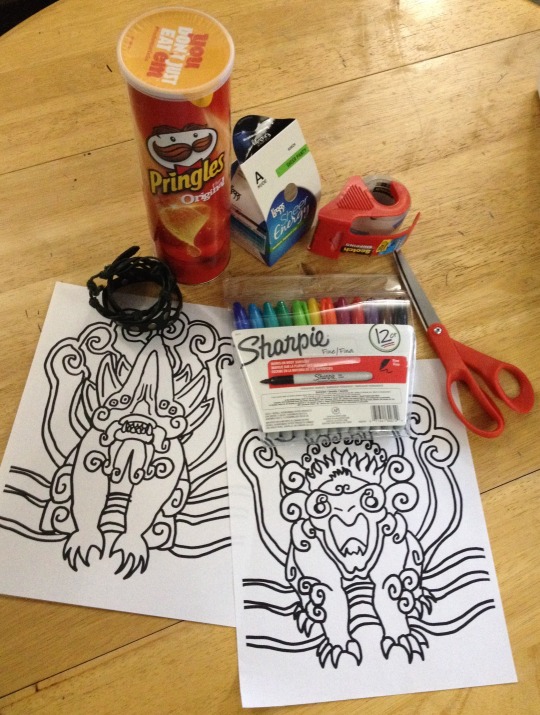
You’ll need a pair of nylons, scissors, tape, a set of sharpies, your designs printed out on 8.5 x 11 paper, some bracelets, and a can of Pringles. You can use any design you want, of course, but Here is the link to these fine Newt Kaiju tattoo designs.
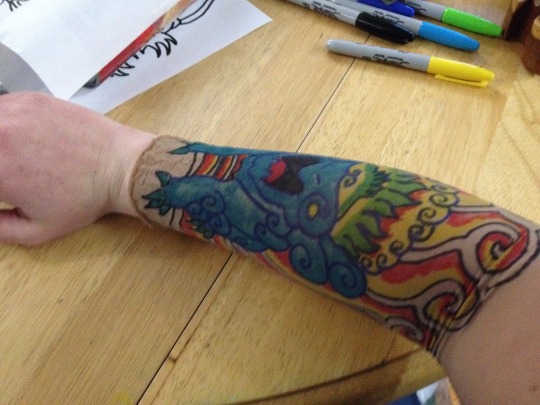
If your nylons have an undies part, cut the legs off and wear the undies on your head for the rest of the tutorial, if desired. Put the legs on your arm like so, and cut the toes off so you can slip your hand through. You can cut some of the top of the sleeve off as well, but don’t cut too much because you can’t put it back on if your sleeves are too short.
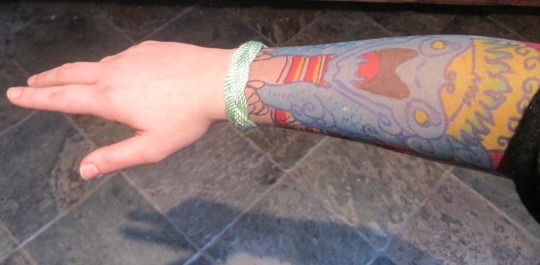
Here are my creepy sleeves. Now for the pringles.
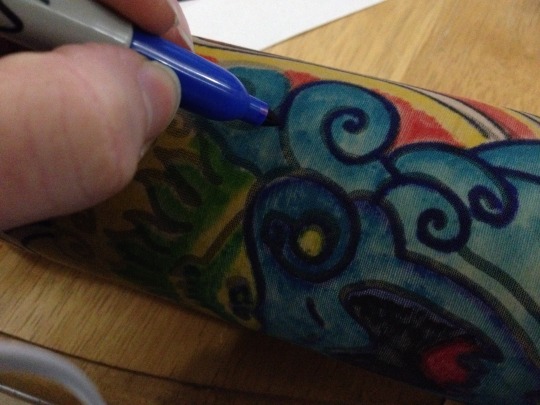
Tape your design template to the Pringles can. It doesn’t reach all the way around but eh. The Pringles can gives you a nice stable surface to draw on that is roughly the shape and size of an arm. It’s a little short, so just roll up the rest of the nylon above the workspace and adjust both template and nylon down when you get to working on that part of the sleeve.
Color with the markers! I recommend doing the colored areas first and then doing the black outlines on top of it, to avoid the black ink contaminating the ink pads of the lighter markers. Remember how that always happens to the yellow ones? Eww. Nylons are thin and slide around a bit, so it’s best to use short strokes and dotting to get the ink on.
Take the template off the Pringles tube, flip the paper to the blank side and put it back on again. The paper collects the extra ink, so it’s hard to see any missed spots. Now you can see any bits you may have missed. Fill them in for completion. Also, the paper doesn’t manage to wrap all the way around the Pringles can, so now is the time to free-hand a bit of the design where the template doesn’t reach. For Newt tattoos, that’s the back of the arm.
When you’re all done coloring, put them on!
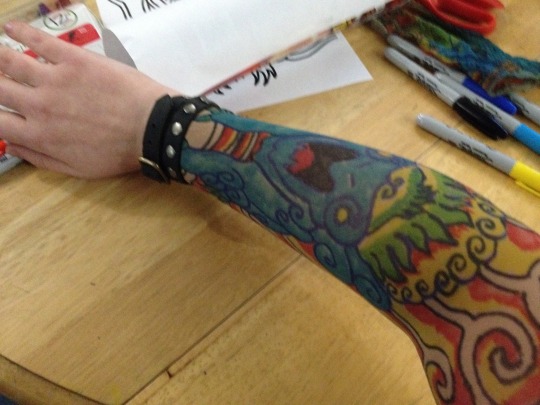
There’s a rough end to the tattoo right at the wrist, of course. Disguise where the sleeve ends and your skin begins with some pretty bracelets:
There we are, much better!
Now…you’re done! Have some Pringles!
SLAMS THE REBLOG BUTTON
from a tattooist perspective: use the navy sharpie not the black or blue for your lines, they will look like healed black ink.
This is amazing. Particularly “if your nylons have an undies part, cut the legs off and wear the undies on your head for the rest of the tutorial, if desired.”








 Avelera