On 17 July 1204 the Venetian
naval fleet broke through the sea wall fortifications of Constantinople, setting
the city on fire and marking the conclusion of an episode of the Fourth
Crusade. The armed invasion convened by Pope Innocent III from 1202 had as its
aim the conquering of Jerusalem. In an effort to gain access to trade routes as
well as military advantage, the Western European crusaders instead became
sidetracked, engaged in a battle with the capital city of the Eastern Greek
Orthodox Byzantine Empire.
Condemned even at the time for
its scale of violence, pillaging, and desecration, the Sack of Constantinople
(now Istanbul) created an uneasy milestone at the intersection of art and
history. Some of the most beloved monuments in contemporary Venice are spolia
from Byzantium, while others artworks commemorating the event are canonical
masterworks.
The Four Horses of St. Mark’s
Basilica, also called the Triumphal Quadriga, are antiquities originally from
4th Century Rome. The statue group was displayed at the Hippodrome of
Constantinople. In order to ship the horses to Venice, their heads were
severed, and the collars were added to obscure where they had been cut. The
horses were installed on the terrace of the façade of St. Mark’s in 1254. The
Venetians themselves saw the horses looted by Napoleon in 1787; they were
returned in 1815. The originals are now housed inside the Basilica, replaced by
more durable copies on the façade.
The porphyry sculpture of the
Four Tetrarchs, c. 305 (Diocletian, Maximianus, Galerius and Constantius),
inimitably associated with Venice, was taken from the Philadelphion palace and was also
relocated to St. Mark’s Basilica.
The Republic of Venice continued
as a naval power through the Renaissance and Early Modern periods, the city’s
unique architecture and ambiance owing much to contact with the Mideast and its
neighbors along the Adriatic.
Byzantine Bowl, 9th century;
mountings, 10th century; reworked 15th century. The Treasury of San Marco,
Venice. Photo from the Scala Archives, New York City.
Jacopo
Tintoretto, The Capture of Constantinople
in 1204, c.1580-1605, currently in the Great Council Hall, Palazzo Ducale,
Venice, Italy. Photo from Wikimedia Commons.
The Four Horses of St. Mark‘s Basilica,
Piazza San Marco, Venice. Photo from the Scala Archives, New York City.
Topographical Map of Constantinople
in the Byzantine Period. From Wikimedia Commons.
La Conquête de Constantinople, MS. Laud Misc. 587, Geoffroi de
Villehardouin, Venice. c. 1330. The Bodleian Libraries, University of Oxford,
England.
The “Rubens” Vase, Walters Art
Museum, Baltimore, Maryland, Nr. 42562. Carried off
as treasure after the sack of Constantinople in 1204 during the Fourth Crusade
in 1619, the vase was purchased by Peter Paul Rubens (1577-1640).
Portrait of
the Four Tetrarchs (Diocletian, Maximianus, Galerius and Constantius, c. 305),
St. Mark’s Basilica, Venice. Photo from Wikimedia Commons.
There are few things as soul-crushing in the writing process (at least to me) than getting a bunch of characters in a room with the intention of something happening, then the characters proceed to stand around and stare at each other.
Or worse, look at you like this.
My characters didn’t know why they were there. I didn’t know why they were there either. I had no clue what they were supposed to be doing, so I’d start throwing random instructions at them: “Fight, characters! You guys should fight now! Maybe fighting will make this event have a purpose!” Which inevitably resulted in characters going through the motions of battle for no apparent reason, like they had all lost their minds.
What was the problem? I didn’t know how to write a scene. I didn’t know what a scene was. I had a vague definition that it was something about changing scenery, or just “something happening”.
It’s not. And once I learned what a scene was, my characters got to stop pummeling each other, while wishing they could pummel me.
So what is a scene?
The definition of a scene is kind of like the definition of a story. Story is change, a massive change in the life of your main character. A scene is change too, but much smaller, and part of that huge story change. You couldn’t have the BIG change without these tiny changes. Thus, a scene is not switching scenery. It’s not flipping to a new Character’s POV. It’s one segment of change, which triggers the next change, which triggers the next, which gradually build into sequences, which build into Acts, which build into story.
So what goes into a scene? How does it work?
1. Alternating Charges
If a scene opens positive, it will turn negative by the end. If it opens negative, it will end positive. Simple.
2. Character Goals
Everybody in a scene wants something. If they don’t want anything, they shouldn’t be in the scene. And these characters, with their often opposing goals, are going to employ different tactics on each other to get what they want. Which creates …
3. Escalating Conflict
Conflict is created when one character wants one thing and another wants something else, right? So the characters in the scene are each pushing for something different, each new tactic increasing in determination. And what are these actions called?
4. Beats
The beats of a scene are exchanges of action and reaction. One character does something, another character reacts. All exchanges (beats) are pushing the scene onward, building tension and conflict, until finally …
5. Turns & Revelations
The scene turns. The positive has changed to negative. Something has been discovered. The story has spun in a new direction.
6. Connection to Story Objective
Every scene must be connected to the BIG goal of the story, the main character is taking small actions to reach that big goal. If it isn’t obviously connected to this big plot, it won’t make sense. Your reader won’t know why the heck they’re reading the scene. Which brings us to …
7. Logic & Necessity
Every scene must be necessary. It must be able to be linked with the previous scene. “Because that happened in the previous scene, THIS must happen in this scene.”
So! To see how that all works, let’s break down a scene from Tangled. (Because I used it in the last post to map out how a premise works, and my little writer heart can’t resist symmetry.)
Rapunzel’s Goal: Rise up against her mother – finally.
Gothel’s Goal: Regain control.
Escalating Conflict: They’re fighting over who controls Rapunzel, and this battle causes them to go from “mother and daughter” to “enemies”. The conflict builds nicely in this scene, causing the story turn.
Connection to Story Objective: Throughout the movie, the big thing Rapunzel wants is freedom, she wants her life to begin, she wants to have a new dream. This is the moment she figures out how to do that; it’s not escaping the tower, it’s escaping Gothel’s control over her.
So! Here’s the scene.
Beat 1
“Rapunzel? Rapunzel, what’s going on up there?”
Ignores her. Still processing the tremendous implications of this revelation.
Beat 2
“Are you alright?“
"I’m the lost princess.” (Dumbfounded. Almost whispering it to herself.)
Beat 3
“Oh, please speak up Rapunzel! You know how I hate the mumbling.” (Bullying.)
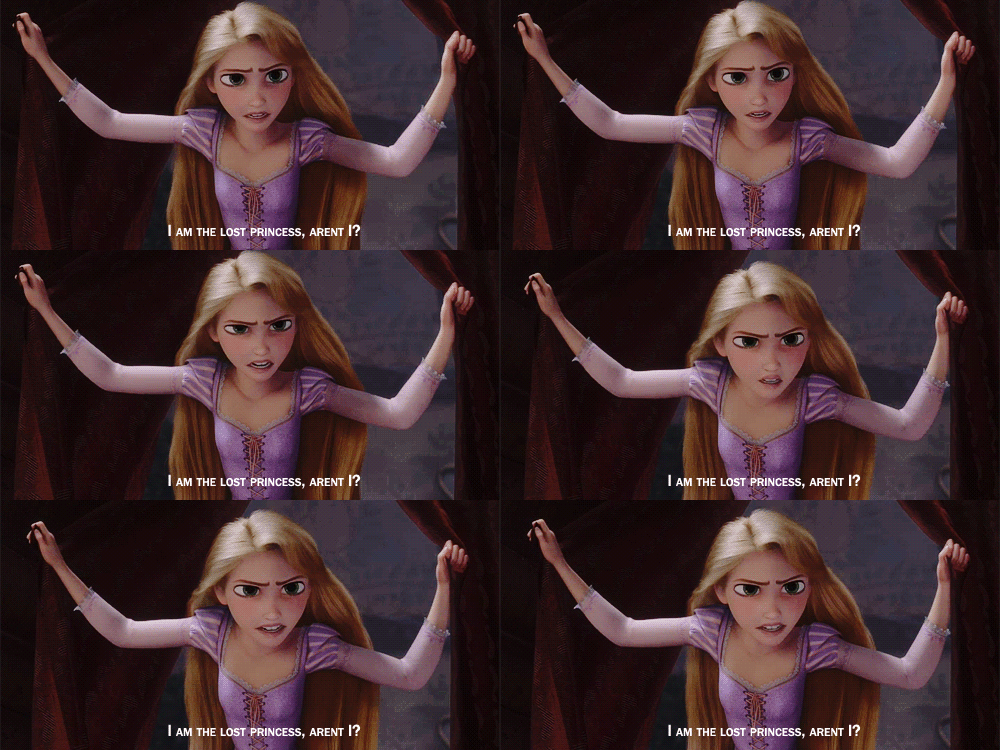
“I am the lost princess! Aren’t I?” (Fighting back. She will not be bullied anymore.)
Beat 4
Gothel stares, stunned. She’s rendered temporarily speechless, because her secret’s been revealed finally, and her victim is actually fighting against her.
“Did I mumble, Mother? Or should I even call you that?” (Accusing. Drawing herself up taller. Looking down on Gothel and glaring. She’s seeing her clearly for the first time in her life.)
Beat 5
After a pause, thinking up a tactic. “Oh, Rapunzel, do you even hear yourself? How could you ask such a ridiculous question?” (Laughs. Ridicules. Attempts to make her feel childish, dumb, worthy of being mocked. Tactics which have always worked. She even begins to hug her.)
Rapunzel pushes her. “It was you! It was all you!” (Still accusing and angry, but pain is beginning to show. It’s almost like she’s giving her a chance to explain herself.)
Beat 6
“Everything I did was to protect you.” (And Gothel doesn’t say anything redeeming. She’s holier than thou, regal, bestowing kindness on an ungrateful, stupid child. Trying to control through guilt.)
Rapunzel rams her out of the way.
Beat 7
“Rapunzel!” (Shouting. Now trying anger.)
“I’ve spent my entire life hiding from people who would use me for my power …” (Leaves her.)
Beat 8
"Rapunzel!” (Still trying the anger angle.)
“But I should have been hiding from you.” (Throwing the truth at her.)
Beat 9
“Where will you go? He won’t be there for you.” (She’s tried everything else. It’s time to attack her heart.)
“What did you do to him?” (Fear)
Beat 10
“That criminal is to be hanged for his crimes.” (She’s keeping up the disapproving mother act, but striking her right where it will hurt her most.)
“No.” (She’s stopped. Shrinking in on herself. Staring, horrified. And Gothel thinks she’s won.)
Beat 11
“Now, now. It’s alright. Listen to me. All of this is as it should be.” She goes to pat Rapunzel’s head, a gesture symbolic of her superiority, her physical, mental, and emotional control over her victim.
Rapunzel grabs Gothel’s wrist. “No! You were wrong about the world. And you were wrong about me! And I will never let you use my hair again!"
Beat 12
Gothel wrenches free, stumbling backwards in shock and anger, breaking the mirror in the process.
"You want me to be the bad guy? Fine. Now I’m the bad guy.” (Well, now emotional control is over. It’s time to start stabbing Rapunzel’s boyfriend.)
This action has no reaction, interestingly. It leaves us hanging, a cliffhanger created with only beats.
Closing Charge: Negative. She’s now a full-fledged villain, the motherly persona shed, and she’s determined to get what she wants whatever the cost.
Turn: It changed from positive to negative, and now we’ve got a Flynn-stabbing witch to deal with.
Revelation: She’s always been evil. She has always been the bad guy. The motherly act was just that, an act.
Logic & Necessity: This scene fits with the previous scene, and the one that follows.
Though I’ve seen these concepts in many books, the place I first learned about it (and the best resource for scene design in my opinion) is the book Story by Robert McKee. It’s helped me countless times, is one of my favorite books on storytelling, and I highly recommend it if you write anything.
I realize that these definitions were a little vague, so I’ll be explaining things more thoroughly in subsequent posts.
Lots of great books on here, especially Mercedes Lackey’s Valdemar Series, Sabriel, and Ella Enchanted.
I’ve been thinking about this topic quite a bit lately, and maybe I’ll formulate a proper essay on it at some point, but it really wasn’t until I was out of college and working that I thought of myself as “female” in the sense that that’s how the world saw me.
A great deal of this might have to do with the fact I stopped watching TV and most movies (except LotR) when I was 12 and stuck almost exclusively to fantasy novels, up until college. Fantasy books like the ones listed in this article dominated shelves, and they had already for the most part moved on beyond “Not just a girl!” feminism. Yes, the female characters would occasionally have to slap down some patriarchal idiot, but those characters were always evil or stupid and anyone worth actually listening to did not share those views. The understanding I took from such books was that there will be such idiots out there, to be sure, but they are very much the minority and likely stupid.
I never really thought of myself as “female” in any important sense, not to dismiss those who did, but for me not dressing “girly” or enjoying feminine things came from lack of interest, not from thinking those things were inherently lesser or wrong. Since most of my heroes were in books and not film I didn’t have any visual of those characters, male and female was about as distinct as being a blond or a brunet insofar as how it influenced the characters’ personalities. I related completely equally to male and female characters. It was simply a given that gender had nothing to do with who the hero was except for some aesthetic details and personality quirks.
Honestly, one couldn’t ask for better role models, but it was jarring later to realize that it was an oasis and not the norm. Even sci-fi, I think, would have been less likely to impart this as a norm compared to the fantasy genre.
If you have never been in, or aren’t around people who’ve been in, I would dearly love to give you a few pointers.
Let me preface this: I love it when people write military fics (be they AU or canon-fic). I love the characterizations, the story arcs you create, and the love with which you create the stories.
But I’d like to help you make the actions of military personnel as accurate as possible, so someone who’s actually in doesn’t start to read your fic and roll their eyes at some of the things you unknowingly write.
-First off, you do not salute in civilian clothes. It’s actually unauthorized. There are only two exceptions to this rule: the President is allowed to salute in civvies, and if the national anthem is playing outdoors, combat veterans are now allowed to salute. (That came about in 2010, for accurate reference.)
-Do not salute indoors, unless during a formation (but I doubt people who don’t have intimate knowledge of drill and ceremony would bother writing about a formation, so that point is mostly just thrown in for shits and giggles).
-The army and air force do not say, “sir, yes sir”. That’s a marine thing (I’m not sure about the navy, since I’m not in the navy, but I’m sure someone else could help out if there’s a question about it).
-Saying “black ops” isn’t really something we do. For the army, you’ve got SF (which is how we refer to special forces–the guys you’re probably thinking about (”green beret” is an old term for them that’s not really used anymore)) and Rangers for the two big special operations forces. SEALS are the navy force, and I apologize, but I don’t know the other branches’ special forces. Again, ask someone who’s served in that branch.
-People don’t usually refer to themselves (or others) by their ranks. Exceptions are usually made if hanging out with people from your unit speaking about a superior, such as “Yeah, LT and I were talking the other day and …”.
-Sergeants are not referred to as “sarge”. You have no idea how many people got the shit smoked out of them in basic for that error.
-Army goes through Basic Training (or Basic Combat Training now; BCT for short), and marines go through Boot Camp. Yes, there is definitely a difference in terms. Army people tend to refer to their initial training as simply “basic”. I don’t know about marines or other branches.
-Calling someone “Soldier” is really something only done on TV/film. It’s usually mocked by people who are in.
-In the army, it is against regulation to just stick your hands in your pockets. We mockingly call them “Air Force gloves”, though I don’t know if they typically put their hands in their pockets. There is also a big stigma against wearing “snivel gear”: the poly pro cold-weather protection gear worn underneath your uniform.
–The everyday Army uniforms are called ACUs (Army Combat Uniform). They are never called anything else, but especially not fatigues. If you’re going back to 2003 or earlier, the uniform was BDUs, or the Battle Dress Uniform. The tan uniforms worn during the Gulf War and first few years of Operation Iraqi Freedom (OIF) and Operation Enduring Freedom (OEF; Afghanistan) were called first chocolate chips (gulf war-era) and then DCUs (Desert Combat Uniform).
-The dress uniform is called something different depending on what time period you’re going for. Saying “dress uniform” is usually a good bet, because you’ve also got Class A’s, Class B’s, ASUs, Dress Blues, Khakis, etc.
-Typically when meeting someone else who’s in, the first things you ask are, “What’s your MOS (military occupational specialty–your job)? Where were you stationed?” Giving out rank and deployment backgrounds out of the blue don’t usually happen.
-Time spent in the military is usually referred to as simply being “in”. “How long were you in for?” is heard way more often than “how long did you serve for?” That question is usually asked by civilians.
-There are enlisted, and there are officers. Enlisted are those who start out as privates, work their way up through the NCO, or non-commissioned officer ranks: sergeant (called “buck sergeant” in a derogatory term for someone who has been freshly promoted), staff sergeant, sergeant first class, and eventually get to first sergeants and sergeants major after fifteen to thirty years in. Officers also usually start out as privates and specialists, then graduate from college and commission as second lieutenants (the derogatory term is “butter bar” and is usually used in reference to said officer’s lack of experience and knowledge) before working up to first lieutenant, captain, major, lieutenant colonel (”light colonel”), and colonel (”full bird”). The general timeline is making captain (”getting your railroad tracks”) after about 5-8 years for competent officers, and spending 5-10 years as a captain.
-We do not stand at parade rest unless forced. Ever.
-Or at attention.
-When talking to an NCO, a lower enlisted will stand at parade rest. When talking to an officer, an enlisted will stand at attention.
-The highest ranking NCO is lower ranking than the lowest ranking officer.
-If you want to throw in some humor, if there is a lower enlisted (E-4 (specialist) or below) joking with an NCO, and the lower enlisted says something, the NCO can snark back with, “I’m sorry, I didn’t hear you because you weren’t standing at the position of parade rest.” It’s a dick move usually to call people out for that, but it happens often enough that if you put that in a fic, someone who’s in will likely laugh at that for a few minutes.
-There is a term for a slacker in the army called POG (pronounced “pohg” with a long o). It stands for Personnel Other than Grunt, meaning everyone who’s not infantry. The term has transformed to mean anyone who shirks their duty or is kind of a shitbag and should be kicked out.
-There’s also a bit of a stereotype that infantry are made up of dumb guys, because you don’t need a high GT score to get that MOS. Their nomenclature for their MOS is 11B (eleven bravo), which is often referred to as an “eleven bang-bang” when trying to insult them.
-If someone is making someone else do push-ups, they do not say “drop and give me x number”. They’ll tell them either to push, or tell them to get in the front-leaning rest. The front-leaning rest position is the starting position for the push-up.
-Usually referring to basic training and AIT (advanced individual training, where you learn your military occupational specialty), you get “smoked” on a regular basis. This refers to PT (physical training), usually in the form of push-ups, flutter kicks, and sprints. It’s not fun. One of the least favorite phrases to hear in basic is, “Platoon, attention! Half-left face! Front leaning rest position, move. In cadence! Exercise!” Because that is the full command for getting people to do push-ups. There is literally no other reason for the half-left face movement. It honestly exists only for push-ups.
-It is awkward as fuck to be told “thank you for your service”. It’s wonderful that people want to show their support, but it is very difficult to respond to that without sounding like a douche.
I know I said a lot about basic training in there, but that’s because I tend to read a lot of fics that are either about basic or about deployments. I can give some pretty firm answers on basic, but everyone’s deployment is different, and I also could be violating a shit-ton of OPSEC (operation security) by telling you guys specific details about deployments. Everything I’ve told you is information you can look up on your own on the internet, but this is a bit more insider’s culture for you to help make your stuff more accurate.
And if you ever find yourself writing a military fic and have questions, by all means, inbox me. I’ve been in for almost nine years and I do have one deployment under my belt, so I can give you accurate army info. I’ve never served in any other branch, though, but I can probably give you a little bit more accurate info than what the movies do if you’ve got general questions.
Also, if you’ve got questions about PTSD, I can help with that. It’s not the cake walk that a good deal of fics portray it as, and it doesn’t always involve nightmares and aversion to touch. It can present as depression, intense anger issues, pulling away from loved ones, driving in the middle of the road, freaking out over pops, bangs, crashes and other unexpected noises, being easily startled by things other than noises, hypervigilance, the inability to sit with one’s back to the room, sudden bouts of anger, depression, tears, silence, or mood swings, among many others.
-Also, please, please, if you’re going to write about someone with a disability, or something that gave them a medical discharge, talk to me about the VA first, unless you’ve got a lot of knowledge about them. Not only am I in, but I’ve also worked professionally for the VA, some of that time in enrollment and eligibility, so I know a lot about disability pensions, who would qualify, what type of benefits they would qualify for, etc. I also know the ways that people can accidentally get screwed over from the VA. (It’s actually one of my long-term professional goals to change some of those things, so I am very passionate and very knowledgeable about it.)
TL;DR: I know shit about the military and the VA. Ask me if you have accuracy questions.
I got an email from a reader earlier. The sender was a lovely young woman who had just re-read my first published fic and wanted to tell me how much she enjoyed it—how it made her feel, how it made her smile, how it made her cry, how it made her excited to get home each night and curl up in bed with it, how it helped ease the pain of a difficult patch in her life, and how much she misses it now that it’s over. It was a beautiful letter, and my reaction to it must have been visible enough to make my saner half take notice from across the room. He shot me a questioning look, and I turned the laptop around and gestured to the screen.
I followed his eyes as they scanned each line, saw his lips tip up in a smile that grew broader as he read, then braced myself for the good natured snark I’ve come to expect when my little literary hobby comes up in conversation.
“Wow.” He said. “That was kind of amazing. How does it feel to be someone’s favorite author?”
“Don’t be a dick,” I said, slapping him on the shoulder.
“I’m serious,” he replied, gesturing to the screen. "That’s what she said—right there: You’re my favorite author.”
“I think she means favorite fic author. Not real author.”
“Is there a difference?” He asked.
“Yes,” I said, rolling my eyes. ”Of course there is.”
“Why?”
“Because, as someone in this room who isn’t ME is fond of pointing out, self published gay mystery romance novels aren’t exactly eligible for the pulitzer.” I said, turning the computer back around.
“So what?” he shrugged, “Something you wrote inspired a stranger to sit down write what it meant to them and send it to you. A lot of total strangers, as a matter of fact. You write, people read it and react. That makes you an author.”
“Huh.” I said, very eloquently, then got up and went into the kitchen to start dinner.
Hours later, sitting down to reply to the letter in question I find myself writing this post instead. Because here’s the thing: That wonderfully crazy man who lives in my house is right. (But please don’t tell him I said that)
From the moment I realized that letters made up words and words made up sentences and sentences made up worlds that were mine to explore any time I wanted to I’ve been a reader. I have fallen in love with perfect phrases and epic stories and countless characters pressed between the pages of the thousands of books I’ve read in my life so far—and sitting down to string together those same 26 letters into tens of thousands of words of stories I felt needed telling? That makes me an author.
I have adored the work of countless authors in numerous genres, and the world of fan fic is no exception. I have admired and cherished and savored the words of talented writers whose work is no less legitimate for the fact that their names include random keyboard characters and their words don’t live on bound paper on a shelf.
It’s not JUST fan fic. It’s literature. It’s published. It’s read. It’s loved.
It matters.
Thanks to all of my favorite authors for every word on every page on every screen that I’ve ever loved.
Reblog for the sweet anon who asked me if I thought fanfic was as important as “real” fiction. Hope this answers your question. 🙂
Thanks for reading my work, so happy you’re enjoying In The Library!
Read this. Take it to heart. REMEMBER IT.
Comments are the best
They really are. Anything that manages to touch another person, make their life – their day, a particular minute – better is invaluable.
“Let us not desert one another; we are an injured body. Although our
productions have afforded more extensive and unaffected pleasure than
any other literary corporation in this world, no species of composition
has been so much decried. … There seems almost a general wish of
decrying the capacity and under-valuing the labour of the novelist, and
of slighting the performances which have only genius, wit, and taste to
recommend them.“
–Jane Austen, defending that most reviled of genres: the novel.
As Joanna Russ says in How to Suppress Women’s Writing, “Jane Austen … worked (as some critics tend to forget) in a genre that had been dominated by women for a century and one that was looked down upon as trash, a position that may have given her considerable artistic freedom.”
This is us, now. This is fanfic.
Russ also writes that “women always write in the vernacular. Not
strictly true, and yet it explains a lot. It certainly explains letters
and diaries. … It explains why so many wrote ghost stories in the
nineteenth century and still write them.”
As I’ve said before, what is more vernacular in the 21st century than ephemeral, fannish internet porn? This is us. We are part of the long tradition of women writing and being told their writing is not real and does not matter, that the things we love and value are worthless and foolish, for so long that we even begin to believe it.
Our work is real work. Our writing is real writing. Our stories matter. Our community matters. We are here, together, doing this thing. This is real life. This counts. If you write something on the internet, you write it in real life.
Fanfic matters. Fanfic is literature. Fanfic is literature that breaks the bounds printing technology and capitalism once imposed on the wide distribution of the written word. Copyright law, royalties, the logistics of producing and selling paperback books, none of those can touch the heart of what a story is. None of those make your story any less a real story that can really touch another person.
If anyone tries to tell you different, you can tell them Jane Austen begs to differ.
Fanfic is never just fic.
I’ve had someone tell me I literally saved her life, by giving her something to look forward to, to keep reading. I’ve read stories that’ve made me get teary and smile and stay up until 3am.
Fanfic works on an emotional, connective, affective, aesthetics-of-pleasure level. This is a different function from most ‘mainstream’ literature, as the professors over at fangasmspn have pointed out in their academic book on fandom. It serves a different purpose–one that’s closer to romance novels or other ‘pulp fictions’. This is not to denigrate either function–we need to know how to read Shakespeare or Chaucer, how to think objectively and analytically about lives lived in other places and times, how to read factual scientific pieces for data, how to engage with the literature of ideas–by which I mean idea-driven rather than character-driven (and most literature blends the two; it’s not a hard-and-fast boundary).
Fanfic serves a different and equally valid purpose: community, social engagement, empathy, emotional catharsis, subversion of traditional conceptions re desire and sexuality, exercise of pleasure and reclaiming of the importance of pleasure, aesthetic appreciation, creativity plus appreciation for others’ creativity, and as Larsen and Zubernis point out in Fandom at the Crossroads, a form of healing that’s potentially both individual and collective, involving a space for exploration of identity and identification.
Thank you Cass for bringing Bourdieu in your tags! It’s such a crucial part of the discussion about fanfiction, and why it is always judged as the opposite of “true” (read “noble”) literature. Yes, there is a gender aspect to it, but we should never forget that when we talk about “culture”, we necessarily talk about class.
as someone who spent a lot of time this week arguing for the basic legitimacy as fan fiction as a fucking form (and i’m not even a big fic reader), this resonates. this is so good.
It’s so strange when this shows up on my dash from time to time…like a weird little gift from the past.
But for the record, I still believe every word.
When you freely pump out multiple 100K+ word fics, it’ll never be ‘just fanfiction’. When you sit there researching the type of insults used in 1980s Japan for a fic, it’ll never be ‘just fanfiction’. When you memorized the parliament and government history about a small island nation off the coast of the African Continent, all so it can be briefly mentioned in your fic for like 5 paragraphs, it’ll never be ‘just fanfiction’. When you are crying because you don’t want to disappoint your readers, especially those who bother to let you know their thoughts, it’ll never be ‘just fanfiction’.
‘Just fanfiction’ is a fucking insult if I ever saw one.
I love all of the writers I follow but the two who are always amazing are @bairnsidhe and @infinisei
Thank you my dear.
Also, I agree with all of this. When you drag yourself from your sick bed to slam out a few hundred more words of heartbreak before dosing yourself with cold medicine, it’s not ‘just’ anything. When you carefully collect trivia like “what candy was available for what costs in 1935?” and “How did you say ‘gay’ in 1870?” and “What sorts of PTSD treatments were available in Norse villages?” and “What city in 1997 had a big enough crisis to merit a special forces team?” to write stories with, it’s not ‘just’ anything.
When you know for a fact your readers have used your fics to survive the worst of all possible things, that they have stayed alive through trial and pain because they needed to know what happened next, when they’ve fucking told you that you gave them hope and comfort in their darkest hours…
It’s a lot of things, but “just fanfiction” isn’t one of them.
So yesterday I was reading @silentauroriamthereal‘s Best of Three, again (it’s a really good story!). And I realised that the John in that story is pretty much a total dick. He’s incredibly patronising and self-congratulatory about being such a wonderful friend to Sherlock etc etc etc, all the while being actually unimaginably cruel to Sherlock.
And I left a comment to the effect that I loved the story but hated John, and she very kindly replied that she thought it was pretty in character and I had this absolute oh my god moment because she’s bloody right, isn’t she?
And somewhere between Season 4 and Best of Three and SilentAuror’s comment, I think the scales sort of fell from my eyes with regards to John and the show. It’s not that Season 4 ruined John. Season 4 was the logical continuation of where they had taken the character, arguably from the second episode. Go back and look at the way John talks about and treats Sherlock, all the way back to TBB. Try to reconcile the way John talks to and about Sherlock with the way Watson talks to and about Holmes.
Season 4 John is not out of character. Not for BBC John. It’s extreme, but it’s not actually out of character. We think it is, but I think that we have good reason for that. In my specific case, I knew and loved the canon long before BBC Sherlock came on the scene. I know Watson, and I know how he feels about Holmes. So when John acted the way he did in Season 4, I thought it was awful, and terrible, and it came as a shock to me. Before Season 4, when John acted in ways that Watson would not have, I was like “well, maybe he’s just having a bad day’, but Season 4 made me realise that Watson hasn’t been having bad days, Watson has never been here at all.
We think that John is better and wiser and kinder than he is because we spend more time with the wiser, kinder versions of John Watson that we see in the canon and in fanfiction. We’ve been blinded by those Watsons to the truth of John’s character in the show.
And that leads me to another conclusion. BBC’s John doesn’t love Sherlock. We think he does, because Watson loves Holmes, and whether you think that it’s platonic or romantic or sexual or whatever, you can’t deny that there is love there, but John? He doesn’t love Sherlock.
I think he wants Sherlock. I think he’s addicted to Sherlock. To the cases and the life they lead and the danger and all of it. And I think that, like any addict, he hates Sherlock and everything that comes with him, and hates that he needs him. And that’s why the morgue scene happens. Because John, unlike practically every other Watson in history, does not love Sherlock Holmes. Because John wishes that he had never met him and wishes that he could live without him, and knows that as long as Sherlock is alive, he will never, ever be able to leave him for good.
Which means that yes, they really did do TPLoSH all over again, with a gay Holmes desperately in love with Watson, who doesn’t love him back. Except they dialled it up to 11, because everything has to be bigger and louder and hurt more, and instead of a straight Watson who still loves his Holmes, they have given us a John Watson of ambiguous sexuality who not only does not love Sherlock, but actively despises him.
(I also have some thoughts about how Sherlock has been moving toward becoming Holmes over the course of the series, while John moves further and further away from being Watson, but I’ll save that for another time.)
why do you hurt me???
i mean, especially after s4, i felt more or less convinced that John doesn’t love Sherlock back, certainly not in the way Sherlock loves John so selflessly and unconditionally
but to see you spell it out so well and dial it up some more….. oh my heart….. oh my poor sherlock…. it makes this scene THAT much more painful to watch
I believe you are absolutely right and I think that’s why S4 has been so difficult for me. I had clearly conflated BBC John with all the permutations of John that are fan created. The fan fic and fan art Johns that love Sherlock; that nurture and protect Sherlock from that place of genuine love for Sherlock. S4 John’s character arc is divergent from those fic Johns I have read and I’m starting to see that is on me, not the BBC writers. I now have to figure out if I can go back to the fan created Johns and enjoy them for what they are, and leave BBC John behind. I’m still trying to decide.
@lawyermargo we all did, I think. But the good thing is that fanon John is much closer to canon Watson than John is! I’m not sure if that’s a comfort to you or not, but we are not, and we were not, wrong. The John Watson we see is the real John Watson. It’s the BBC version that’s out of character.
Also, there are other Johns. Try Granada! Granada John is beautiful.
Or read canon and just imagine Martin’s face on it.
@high5sandchocolate, I think this is good analysis of why we’ve been struggling with S4.
I’m so glad someone is saying this and not getting bashed for it. Before S4 I rewatched all of S1, S2, and S3 with my kids. And to be honest, I hadn’t rewatched it all for at least a year, and had been thoroughly and happily buried in fic adaptations of Sherlock and John.
I remember saying to my best fandom friend (not tagging in case this post makes her sad) at the time that seeing it all again after some time and distance made me realize that John wasn’t actually very nice to Sherlock. He was a bit of a dick.
I do believe he cares about Sherlock, and comes to see him as a friend, and I do believe John knows that he owes Sherlock his very life, and he’s absolutely addicted to him as a surrogate for the adventure. But he also blames Sherlock for getting in the way of the happy normal life he thinks he wants. He goes back to Mary because he wants to, because he’s pissed off at both of them, but he wants Mary, and he doesn’t want Sherlock. At least, he doesn’t want to want Sherlock, and he never gets past that. And he hates Sherlock when Mary dies because if there hadn’t been Sherlock, there’d be a Mary. Sherlock is John’s fly in the ointment, his virus in the system.
And I think I went as far as to say that I didn’t think johnlock was endgame, that I would love to see it, because they’re my OTP, but I didn’t think the show had given us a foundation for it. We’d spent so much time in hiatus, consuming fic and seeing subtext in three-second long clips taken out of context, and just simply dreaming and wanting, but I didn’t think it would happen.
I don’t like it. I don’t like having my johnlock-colored glasses ripped off, but John didn’t turn into a dick. He kind of always was one.
And maybe that explains why I’ve found myself drawn more and more to Victorian johnlock lately, and why I don’t really write fixits, preferring AU.
At the end of it all I still find myself shaking my head and asking, “This? This is the story they wanted to tell?”
As a liberal person doing my best to be skeptical, I thought any impeachment proceedings would be dull affairs. Even with the drama of the Yates hearing I thought, “Nah, it’s not going to be some huge bombshell. It’s going to be the work of quiet, dedicated people, someone who digs through his finances and finds that one niggling thread that unravels the whole thing. It will be the patient work of months, if not years of effort, if there’s anything at all. Capone was taken down by the IRS, and all this White House needs is a little breathing space to tighten their grip, a little quiet, and people will settle into business as usual and only because of things we set in motion now will there ever be a prayer for impeachment, but by then the public will have forgotten about it and it will come as a shock, and THAT’S if we’re lucky.”
AND THEN HE FUCKING FIRES THE PERSON INVESTIGATING HIM AND I JUST CAN’T EVEN LIKE literally HIS OWN SIDE is now calling for an investigation that they were PROBABLY WILLING TO BURY had he not been so BALLS TO THE WALLS STUPID as to keep calling attention to this fucking thing like how smart does he think he is? How dumb does he think anyone else is? I’ve seen FIVE YEAR OLDS with more ability to cover up their guilty conscience holy shit like does he REALLY THINK that will distract people? Does he not REALIZE how many small infractions he’s committed that will come back to haunt him and his family if he ever TRULY pushes his outrageous behavior over the edge? The minute the GOP turns on him he’s FUCKED and he just made it VERY hard for them to stay on his side without looking complicit I mean just holy shit did he think that the President is a king who can just wave a hand and make everything against him go away? I once though it was IMPOSSIBLE for anyone to be that stupid but now I SERIOUSLY THINK THAT’S THE CASE I am literally breathless with aghast wonder, he is god’s gift to the opposition, he is his own worst enemy, I cannot BELIEVE–
@avelera sweet fanfic sis who had the unluck to ask for fic recs from a rabid sw fan *blows kisses*
Criteria: Star Wars gateway fic for people who haven’t really been exposed to fanfiction before and have only watched the original trilogy, gen or canon pairings only
“Fuck you,” Leia says. “Who said anything about getting married? Did Luke say anything about getting married?”
“Luke is not involved,” Luke says, not looking up.
“Hey, Luke is not involved,” Han says, pointing at her. She’s going to bite his finger off, then they’ll see how much pointing he can do with it. “This is about you and me, princess.”
“There’s not going to be a you and me,” Leia says. “I’m going to have this baby with C-3PO.”
C-3PO says, “Madam,” tremulous.
A CLASSIC. Definitely has been rec’ed before but I’m adding to this list bc I’m a completionist. Wonderfully characterized Leia and great trio interactions overall.
“I’m Leia Skywalker,” she says, and there is something unfathomably life-changing about that little declaration. “We’re here to rescue you!”
ANYTHING BY PHIL IS EXCELLENT TBH. This is only the first in an entire series of fics and they are honestly all worth the read, the Skywalkers are happy and nobody is dead and sand trash child Leia will happily kick anyone’s ass. If you’re interested in delving into EU territory theirOrgana-Solo kids fics [x] are also absolutely terrific.
The one where Vader turned double agent for the Rebellion about three years after ROTS, and Leia is now his primary contact with the Rebellion.
This entire series is a Star Wars fandom mainstay and has inspired countless offshoots of fanfic, worldbuilding, and meta. I would personally suggest starting with Decryption Codes [x] before starting chronologically because Leia makes a good introductory POV for someone who’s never watched the prequels, but almost any order works.
anonymous asked: What if Luke and Leia were “switched at birth” (or rather, the difference is how they were split)? Prince Luke Organa? Leia Skywalker?
–
When she is nine, Leia sits her uncle and auntie down and, small face screwed up with determination, asks for an increase of her allowance. She has prepared points and counterpoints. She cites both local and intergalactic codes of labor law.
Her uncle frowns at her for a long minute once she’s done. She holds his gaze, stare for stare, chin untrembling, because that’s how he’d taught her to when they went to barter for parts at Toshi Station.
“Alright,” he says.
“My bedtime should be pushed an hour later, too,” Leia tries and her aunt laughs and tells her to go do the dishes.
When Leia is twelve, she organizes all of the children of local farms into a union. Their parents think they’re kidding until they hold their first strike.
Short and sweet, another great take on the age old question of “what if Luke and Leia’s guardians had been switched?”
Luke’s face turns puzzled, bemused. Leia hurries to continue before he can stop her. “I don’t have a great destiny. I haven’t been to any swamps seeking old mentors, I don’t have Kenobi looking over my shoulder to make sure I do the right thing.”
“You’re my sister,” Luke says, and she doesn’t know how to make him understand.
OR: The one where Leia trains in the Force.
This fic is near and dear to my heart if only bc it shows the messy anger and unfinished business of the rebellion after their big victory on Endor; Luke is struggling, Han gets into fights, and Leia, well. Leia trains in the Force. Another great fic for trio dynamics and how the three of them support each other through difficulties.
An Imperial officer loses a bet and has to get Darth Vader a present for Life Day.
WHERE DO I EVEN BEGIN. Immediately believable original characters that bring the bureaucratic humdrum evil of the Empire to life, wonderful writing, THE PREMISE. Will leave you ugly laughing.
It happens every day. Significant on the individual level, but a hopeless mass of noise from a distance. Luke only notices this time because it’s Leia.
Something is there that never was before.
Another short and bittersweet ficlet feat. anger!flirting Han/Leia and terrified wonder “i’m going to be an uncle!!!!” Luke
Leia is growing in fits and spurts, eating greedily and crying loudly. She stays in a sling on Padme’s chest when they move, Luke held snug in a sling around Obi Wan’s. Luke gets a whole head of thick brown hair while Leia’s is still patchy and bald, but he never matches his sister’s powerful lungs.
When Padme had been sitting in her high senatorial apartment on Corsucant, holding Anakin’s sweaty hand, she had never imagined she’d be murmuring desperately soothing noises to her fussy daughter while she shot around a corner at stormtroopers, while R2D2 meddles with a ship’s blast doors behind her.
Luke starts teething on a hot jungle planet where they hunker down for three weeks, sleeping in an abandoned old temple and catching the local wildlife for dinner. Leia takes her first steps in the belly of a Corellian freighter they’ve stowed away on. She wobbles between Padme’s outstretched hands and Obi Wan’s knees and boxes of smuggled luxuries. When she falls down, Obi Wan surges forward, heart in his throat, but Leia laughs.
OKAY TECHNICALLY THIS IS NOT PURE ORIGINAL TRILOGY but it’s still wonderful and honestly if someone’s never watched the prequels they could still 100% enjoy it and understand what’s going on. A personal favorite and a fanfic gold standard.
This should be a solid enough list to get anyone started; if you’re willing to delve into more prequel or sequel trilogy inspired stuff there’s also a lot of fic with timetraveling shenanigans, inter-generational family drama, and Luke, Leia, and Han trying to solve the galaxy’s problems during any given era.
Happy reading! Hope this was helpful, feel free to hmu if you’re wondering about anything more specific.
Somewhat of a random question, but hypothetically speaking, let’s say that Tolkein’s Hobbit/LOTR and PJ’s Hobbit/LOTR takes place in two different parallel timelines, possibly existing as one at some point before branching off into two different paths. What would you say was the inciting incident that cause the divide into two divergent paths between the more innocent timeline and the darker timeline?
Been thinking about this one since I saw it, actually! I mean, obviously PJ took liberties, telescoping a lot of Middle Earth history and just plain altering it to better fit a cinematic medium. I kinda feel like the differences in the stories of LotR and The Hobbit aren’t so intertwined that it would be the same event for both? But here’s my theories:
1) In LotR: Elrond witnessing Isildur’s failure. At least, under those particular heartbreaking circumstances, Isildur’s nasty little smirk etc. I think he also saw it in the book, but in the movie he’s just way more salty about Men in general and it feels to me like he passed a lot of his distrust of Men onto Aragorn in the form of a sort of internalized racism. A lot of the biggest changes in the LotR movies are around Aragorn’s ancestry – his self doubt over Isildur manifesting as him NOT seeking to become king but in fact being a reluctant king, which creates tension between him and Boromir, perhaps even in some way informing Faramir’s “choice” to try to take the Ring rather than give it up, though that’s a stretch. I wanted to go for an event as far back as possible, but Elrond’s attitude towards Men and the possible repercussions of it strikes me as a strong potential “divergence point” between the books and the movies to explain their differences.
2) In The Hobbit trilogy I’d have to say it’s Azog surviving the Battle of Azanulbizar. Obviously that whole battle went way different than in Tolkien’s writings, since it was in itself revenge for Thror’s death, Thror died before the battle in the books. Maybe that could count as the divergence point. But let’s think of it this way: Thorin takes on Azog instead of Dain, wounding him instead of killing him. This makes Thorin immediately a more heroic figure, so he’s less of the foolish treasure hunter that we see in the book. He’s got more purpose as the bearer of his own heroic legacy and the burdens of it. Azog is alive, Dain never killed him, so you have all the nastiness that falls out in the trilogy because the Company is pursued by a persistent nemesis instead of a series of rather ridiculous circumstances.
Furthermore, because Thorin’s experiences have made him a different person, Bilbo sees him differently, so he’s not snarking about this absurd windbag leading the party, he’s actually very respectful of this solemn and fairly quiet hero that Thorin has become. There’s a connection between them that in the book never really came to light until he saw Thorin’s heroic charge in the golden armor, just before their final parting. Perhaps Thorin himself had never known heroism until that charge, and it transforms him into someone Bilbo can respect in the final hour. Well, for having killed Azog, he becomes someone Bilbo can respect much sooner. The feel of persecution perhaps also exacerbates Thorin’s madness in a way that it’s not in the book, because he really has evidence of people out to get him (Azog) in a way that the book only had by chance.
(Also one of my favorite fanfics ever (which is devastatingly incomplete) plays with the idea that Bilbo’s first lifetime follows the book, but he goes back and relives it and it becomes the movie timeline and I adore it so much it’s called (Un)Familiar Ground by the Feels Whale)







 Avelera