The thing about giving yourself permission to half-ass things is that it’s not just a way to ensure something-as-opposed-to-nothing gets done: sometimes it can also be a way to trick yourself into whole-assing things.
I know this ain’t universal, but for me, executive dysfunction often boils down to my brain balking at the number of steps a job nvolves. If a particular job involves, say, five different sub-tasks, my brain will go: “man, I can’t do five things – that’s too many things; this job is impossible” – even if each of those five things is quick and easy by itself.
So what I’ll do is pare it down. I’ll say to myself: “okay, I’ll only do one or two of the things”. It’ll be an extremely half-assed job, but half an ass is better than no ass at all.
Now, here’s the trick: once those two things are done, it’s much easier to say “hey, since I’ve gotten this far, I might as well do the third thing as well – I mean, I’m already here”. And, well, now that I’ve done the third thing, there are only two things left, and I’ve already demonstrated that I can do two things, so what’s my excuse?
Of course, that was the plan all along. The catch is that I can’t go into it intending to do the five things one at a time; five things taken one at a time is still five things, and my brain goes “nope – impossible”. I have to honestly intend to half-ass it, even though I know that once I start the momentum will probably carry me through doing it properly.
And that’s why brains are dumb.
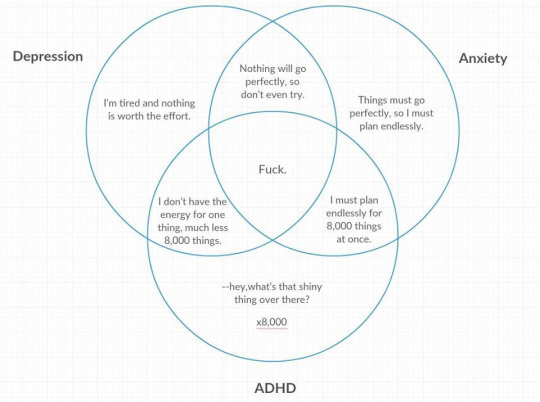
great advice on dealing with executive dysfunction, which is common in ADHD as well as anxiety and depression!
ADHD is related to several sleep problems, but the most frequent seems the delayed sleep phase syndrome, a disturbance of the circadian rhythm. Research of children and adults with ADHD (when compared to controls) shows that the majority of these individuals has a late sleep onset that is associated with a late onset of the sleep hormone melatonin (van der Heijden et al, 2005; van Veen et al, 2010). Melatonin is produced by the pineal gland in the brain when it is getting dark in the evening, and we wake up by light in the morning. The onset of the melatonin production helps to fall asleep. For most adults the onset of melatonin is around 9.30 pm; in ADHD children compared to controls this occurs at least 45 minutes later, and in adults with ADHD even 90 minutes (van der Heijden ea, 2005; van Veen ea 2010). After melatonin onset, it normally takes 2 hours to fall asleep, but in adults with ADHD it takes at least 3 hours (Bijlenga et al, 2013). So it does make sense that so many people with ADHD have difficulty falling asleep on time. This late onset of melatonin is driven by genes that regulate the biological clock, and those genes have been linked psychiatric disorders like ADHD and bipolar disorder (Landgraf et al, 2014). What the exact relationship is between this late sleep pattern and ADHD is still unknown.
adhd mode 1: I want to do this thing!!!! I’m going to do the thing!!! *5 mins later* this is so exhausting lets not do the thing, I’m done
adhd mode 2: *hyperfocus on the most irrelevant, completely unwarranted task in the world* “where did the sun go?”
adhd mode 3: *cue panic-induced motivation, typically offset by: an exam in 1 hr, a 10 pg paper due at 8AM, and other anxiety-stricken deadlines*
adhd mode 4: I want to do something but I don’t know WHAT I want to do, I want to do a million things *spend an entire day restlessly moving from task to task*
adhd mode 5: I’m READY to be PRODUCTIVE! But first, I need to get a cup of water. But wait, there’s no ice in the freezer let me make ice. Hold on, all the cups are dirty, time do the dishes lol. Hm… there’s dishes in my room let me go get them. Oh, there’s my computer let me go check Tumblr. *5 hrs later* What was I just gonna do
Other people with adhd: racing thoughts! Multitasking! Gotta go fast! Gotta do everything!
Me: there’s honey in my mind making my thoughts slow and difficult, my mind is a black hole censoring my thoughts when I try to think, losing time, perpetually high, static Static STATIC
actually, this is a good description of how ADHD predominantly hyperactive-impulsive and predominantly inattentive can present themselves in some cases
people saying that they’re both somehow… let me introduce you to the wonders of the combined type!
Definitely have the thing where I’m always racing in order to make up for the inattentive and slow times. Still haven’t found meds that ideally suit me but finding more posts and descriptions of other people’s symptoms helps.

 Avelera